Nasal Polyps or Stuffy Nose? | What do Nasal Polyps look like? | In-office Nasal Polyp Removal in Dallas, TX | Walnut Hill ENT

Before & After CT Scans: Nasal Polyp Removal | Dallas, TX
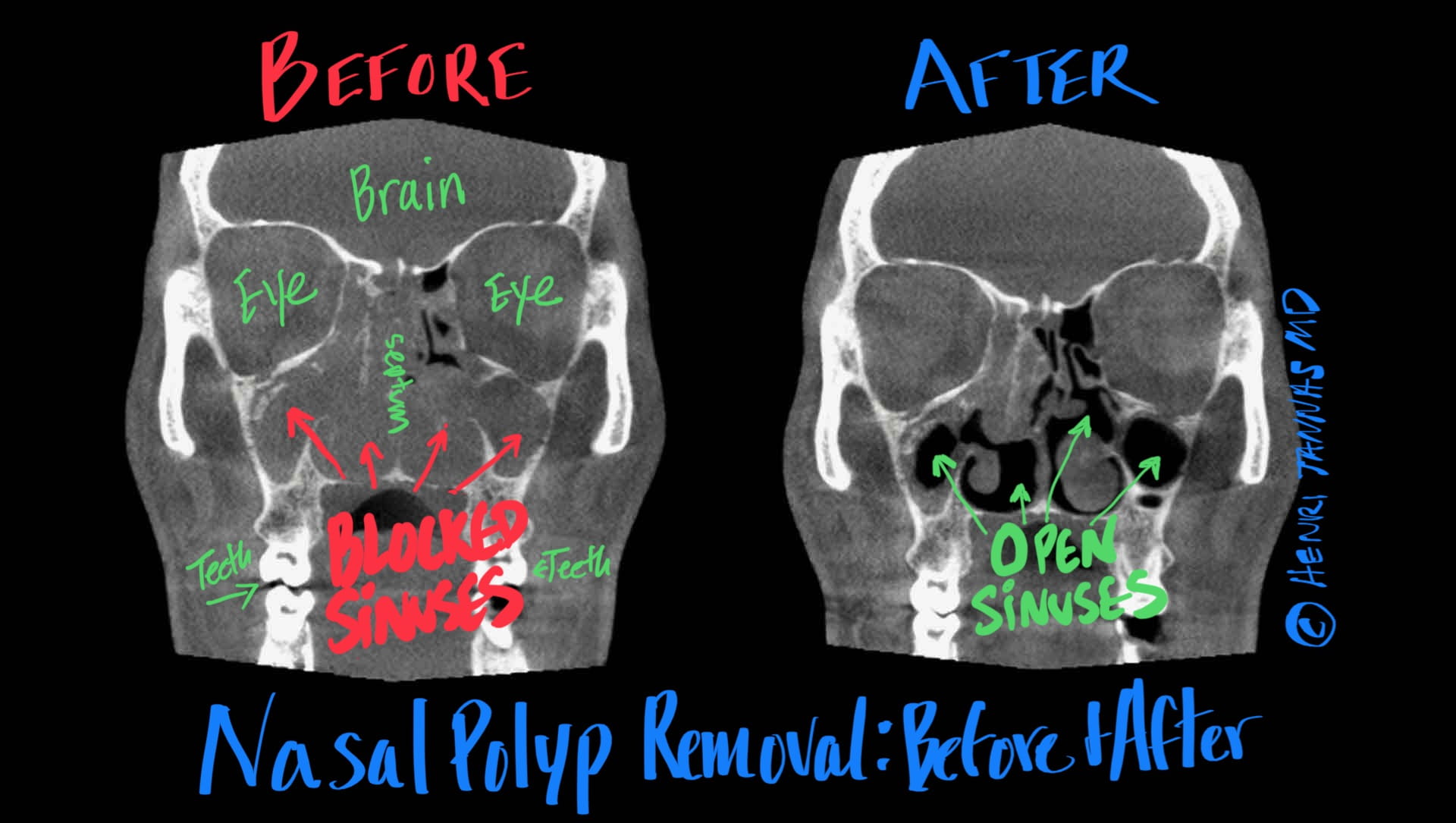
Photo: In-office sinus CT scans & endoscopic nasal polyps surgery by sinus specialist Henri Tannas, MD at Walnut Hill ENT with TIVA anesthesia. Sinus patient reports better breathing, sleep, smell, taste, & less snoring.

Before Nasal Polyp Removal (left)

Gray dense sinuses from inflammation, nasal polyps, pus, & mucus.

After Nasal Polyp Removal (right)

Black open spaces with restored airflow & drainage post-endoscopic removal.
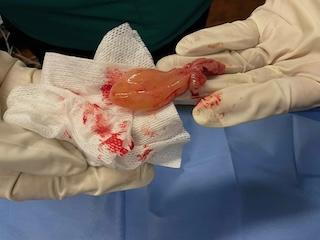
large-nasal-polyp-removed-at-walnut-hill-ent-by-dr-tannas

Photo: a huge 3" nasal polyp removed by Dr. Tannas - just 1/10th of the total polyp volume cleared from this nasal cavity.

Let’s Talk Sinuses (audio)

Dr. Tannas on Before & After CT Scans: Nasal Polyps Surgery

For visual reference, see above.

Sinus Success Story | Nasal Polyp Removal | Dallas, TX

"My wife really does appreciate me having the nasal polyp surgery, because now she can sleep peacefully at night. I can breathe way better, I sleep way better...I feel more alert."

Book a Sinus Consult

What are Nasal Polyps?

Nasal Polyps vs Normal | What are Nasal Polyps?

Patients often say, "my nose feels swollen," "I have constant nasal stuffiness," or "mucus is stuck between my nose and throat." 

Nasal polyps (sinus polyps) are soft, painless, and noncancerous (benign) growths in your nose or sinuses often caused by chronic inflammation. They hang down like teardrops or grapes.

What do Nasal Polyps Feel Like?

People who have small nasal polyps might not know they have them. But having more than one polyp or having a large polyp can block the nose.1 While small polyps may not cause issues, larger ones or clusters can block your sinus and nasal passages, leading to significant breathing problems, facial pain, pressure, stubborn cough, and loss of smell. 

Nasal polyps (aka sinus polyps) are often caused by chronic inflammation from sinusitis, allergies, asthma, or irritants.1  They most often appear between the ages of 30 & 60.2

Nasal Polyps Symptoms

Approximately 25–30% of all chronic sinusitis patients have nasal polyps. 3

  1. Constant nasal stuffiness (often one-sided)
  2. Facial pain & pressure | Sinus headaches
  3. Reduced sense of smell or taste
  4. Post nasal drip symptoms | Mucus stuck between nose and throat
  5. Runny nose + clear mucus
  6. Stubborn cough
  7. Frequent sinus infections
  8. Trouble Breathing through nose
  9. Snoring

Decide whether to book a sinus consult. (Take our Sinus Infection Quiz & get an immediate score without filling out a form.)

Take Our Sinusitis Quiz

In-office Sinus CT Scan + Diagnosis by Sinus ENT

  • Get your sinus answers in one ENT visit
  • Skip imaging center (& hospital gown) 
  • Save your PTO (1 ENT visit vs. 3 appts: ENT + imaging + ENT follow-up)  
  • $150 self-pay add-on with a Sinus Consult (*if insurance won't cover scan.)

Book a Sinus Consult

Nasal Polyps Diagnosis4

  • Video Nasal Endoscopy:A tiny camera shows the nasal passages in detail.
  • Same-visit In-office Sinus CT Scan:High resolution sinus images are immediately available for Dr. Tannas to review, diagnose, & create a treatment plan. The scan takes 20 seconds.

Nasal Polyps Treatments

Natural Approaches

  • Daily Saline Nasal Irrigation: To flush out mucus & allergens.
  • Humidifier
  • Hydration:To keep mucus thin.
  • Avoiding Irritants:tobacco & pollutants.

Medical Management

  • Corticosteroid Nasal Sprays
  • Oral or Injected Corticosteroids
  • Antibiotics or Antifungals:For active infections
  • Leukotriene Modifiers

In-office Sinus Surgery

  • Nasal Polyp Removal (Nasal Polypectomy): removal of nasal polyps (sinus polyps) using various instruments and a tiny camera that go in the nose. Mucus and pus are flushed out. Performed in Walnut Hill ENT's surgical suite under TIVA (Total Intravenous Anesthesia).
  • Balloon Sinuplasty (aka balloon sinus dilation): A minimally-invasive sinus procedure that uses a tiny balloon to gently open blocked sinus pathways. Sometimes used in combination with endoscopic nasal polyp removal.
What is In-office Nasal Polyp Removal?

What is Nasal Polyp Removal?

Nasal Polyp Removal (aka nasal polyp surgery or nasal polypectomy) is a minimally invasive sinus surgery that endoscopically removes nasal polyps using various instruments and a tiny camera. Mucus and pus are flushed out.

  • Improves sinus drainage
  • Enhances airflow & breathing
  • Gives long-term relief from chronic sinus issues 
  • Many return to desk work in days

Walnut Hill ENT | In-house Advanced ENT Diagnostics & Surgical Suite

Performed by a Sinus Specialist

Henri Tannas, MD is a Boston-trained, board-certified ENT surgeon and sinus specialist with 20+ years of endoscopic image-guided sinus surgery experience in nasal polyp removal & balloon sinuplasty.

Book a Sinus Consult

In-office Nasal Polyp Removal: Benefits

  • Minimally-invasive sinus procedure: Nasal polyps are removed endoscopically to improve nasal drainage and airflow
  • Convenient & Comfortable: Doctor's office vs. hospital experience
  • Total IV Anesthesia (TIVA) by board-certified anesthesiologist: Sleep safely.
  • Rapid Recovery: Back to desk work in days. 
  • Cost Effective: less than hospital
  • Covered by most insurances
  • Reduced risk of complications:  no ventilator, no breathing tube soreness. 
  • Long-term relief from sinus pain: a median of 88% of patients report symptomatic improvement.4
  • Balloon sinuplasty is sometimes combined with endoscopic nasal polyp removal & turbinate reduction. Walnut Hill ENT exclusively uses Fiagon Image-guided Balloon Sinus Navigation.

Book a Sinus Consult

The type of anesthesia for in-office sinus surgery matters: TIVA (Total IV Anesthesia)

Do you want to be asleep or awake during in-office sinus surgery? Why Walnut Hill ENT prefers TIVA by a board-certified anesthesiologist.

Green check marks   Walnut ent

In-office - Asleep
IV Anesthesia* | No Inhaled Gases
Fully Unaware | Smoother Wake-up

  • Pre-op Time:  20 mins (IV setup)
  • Procedure Time:  30 - 90 mins
  • Post-op Wake-up:  15 - 30 mins

Total Time: 65 - 160 mins

  • *TIVA (Total Intravenous Anesthesia)1
  • Exclusively IV agents (e.g., propofol); no inhaled gases
  • No memory of procedure
  • Ideal for anxious patients 
  • Only administered by board-certified anesthesiologist (not by a CRNA.)
  • Quicker wake-up2& better recovery quality3than inhaled anesthesia
  • Less grogginess
  • Reduced risk of nausea & vomiting4 5

X

In-office - Fully Awake
Local Anesthesia | Topical & Local Awake & Aware of Surgery

  • Pre-op:  60-90 mins (local injections) 
  • Procedure:  60 - 120 mins*  
  • Post-op: No wake-up (as you never went to sleep)

Total Time:  120 - 210 mins

  • Pre-op numbing phase:  Before lidocaine is injected into the nasal mucosa, the nasal passages are packed with lidocaine-infused cottonoids. Requires rounds of packing & injections until fully numb. 
  • During a sinus procedure, you'll notice sounds & pressure from suction and surgical instruments.
  • If you're claustrophobic or hate a scope in your nose - not a good option 

X

Hospital - Asleep  
Inhaled Anesthesia | Ventilator
Slower & Queasy Wake-up 

  • Pre-op:  60-120 mins 
  • Procedure:  30 - 90 mins
  • Post-op Wake-up:  30 - 60 mins

Total Time: 120 - 270 mins

  • Hospital experience (vs doctor's office)
  • Soreness from breathing tube
  • Grogginess, slower wake-up

Before & After CT Scans | Case Study | In-office Nasal Polyp Removal

For visual reference, see above for the patient's before & after sinus CT scans.

  • Reason for First Visit: Patient couldn't breathe through his nose; suffered facial pain, sinus pressure, & post-nasal drip; snored, slept poorly; lost smell & taste; overall miserable.
  • Diagnosis: After a nasal endoscopy and an in-office sinus CT scan, Dr. Tannas immediately diagnosed severe chronic sinusitis with nasal polyps. Sinuses were blocked with inflamed tissue, nasal polyps, pus, and mucus. 
  • In-office Procedure: After trying conservative treatments such as rinses and antibiotics, patient scheduled an in-office nasal polyp removal. Dr. Tannas removed many polyps including a 3" nasal polyp (see photo above), just 1/10th of the total polyp volume cleared from the nasal cavity. Mucus and pus were flushed out of the sinus and nasal passages with saline.
  • Results: Follow-up CT scan shows significant improvement with restored airflow and drainage. Patient breathes better through his nose, sleeps better, can smell and taste again; significant decrease in snoring (as reported by his wife); previously gray-filled areas now black, indicating air movement; uses daily budesonide sinus rinses to prevent polyp recurrence.

Top 3 Questions after nasal polyp surgery

Just after in-office nasal polyp surgery, our sinus patients (& their spouses ) invariably ask,

  •  “Dr. Tannas, can I see what you just removed from my nose?”  (A: Sure, but only if you promise not to pass out.)
  • "OMG, that polyp is huge. How did it fit inside my nose? (A: It's squishy and malleable.)
  • "Will I breathe and sleep better?" (A: Yes!)

Long-Term Management

  • Regular Follow-Up: Monitoring for regrowth or recurrence.
  • Allergy Management: Treating underlying allergies to prevent polyp formation. Dr. Tannas may refer you to a local allergist in Dallas for allergy testing.
  • Lifestyle Adjustments: Humidity control, avoiding irritants, and maintaining good sinus health practices.

Nasal Polyps FAQs

  • Do nasal polyps grow back after surgery? Yes, they can, which is why ongoing management and follow-up are crucial.
  • Can nasal polyps lead to other health issues? Yes, they can complicate asthma, cause chronic sinus infections, or even contribute to sleep apnea.

Next Steps

If sinus infections, sinus headaches, nasal polyps, or postnasal drip is impacting your life, book a sinus consultation with Dr. Henri Tannas a Boston-trained board-certified ENT surgeon and sinus specialist. Call us at (214) 647-1836 or book your Sinus Consult online. Next-day appointments available. 

Book a Sinus Consult

Contact Us | Contactános

!
!
!

Please do not submit any Protected Health Information (PHI).

Hours of Operation

Monday  

8:00 am - 4:30 pm

Tuesday  

8:00 am - 4:30 pm

Wednesday  

7:00 am - 5:00 pm

Thursday  

7:00 am - 5:00 pm

Friday  

7:00 am - 12:00 pm

Saturday  

Closed

Sunday  

Closed

Nasal Polyps Symptoms & In-Office Removal | Before/After CT Scans | Nasal Polyp Specialist | Walnut Hill ENT, Dallas TX